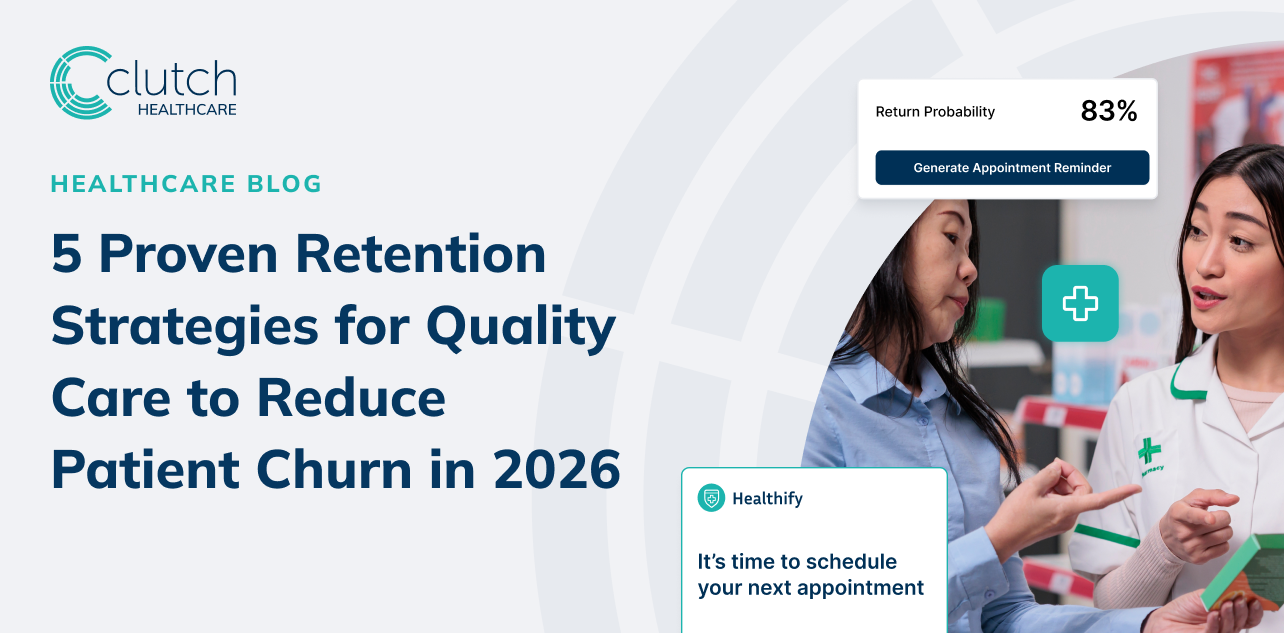
5 Proven Retention Strategies for Quality Care to Reduce Patient Churn in 2026
Patient churn has become a growth problem, a margin problem, and a continuity problem that directly impacts the financial health of organizations. In 2026, healthcare systems are facing higher acquisition costs, tighter budgets, and patients who expect retail-grade experiences. A first visit rarely pays back acquisition spend without strong retention, adherence, and long term relationship value.
Retention has a measurable impact. Higher show rates improve utilization. Better adherence improves outcomes and reduces gaps in care. Repeat visits increase lifetime value and reduce reliance on acquisition spend. For healthcare practices, improved retention leads to greater operational stability and supports long-term financial health. The challenge is execution. Many healthcare organizations still rely on fragmented data, manual outreach, and broad campaigns that miss timing and intent.
Retention matters because it directly affects both patient outcomes and organizational stability. When healthcare organizations improve retention, they create benefits that extend beyond marketing performance and into day-to-day operations, including:
- Lower patient acquisition costs over time
- More consistent care that improves outcomes and reduces gaps
- More predictable revenue across service lines
- Greater long-term operational stability
Clutch Health was built for this moment. Clutch Health unifies HIPAA-compliant patient data, loyalty-style incentives, and AI-driven engagement so health systems and plans drive profitable retention, better adherence, and measurable business impact.
Here are five proven retention strategies to reduce patient churn in 2026, with a focus on quality care, quality healthcare experiences, and quality health outcomes.
1. Make Access Easier, Because Access Shapes Perceived Care Quality
Patients leave when getting care feels difficult. Scheduling friction, unclear instructions, long response times, and poor patient flow create dissatisfaction even when the clinical team is strong. Access becomes part of the patient’s definition of quality care, and providing direct access to care is essential for meeting patient expectations.
Reducing churn starts with removing barriers. Online scheduling, automated appointment reminders, and simple rescheduling workflows keep patients engaged and reduce no-shows. Consistency also matters. A patient who receives clear pre-visit instructions, post-visit follow up, and timely answers feels supported and more likely to return.
Access challenges are one of the most common drivers of patient churn. Some of the barriers that most often contribute to patients leaving a practice or health system include:
- Limited appointment availability
- Confusing or time-consuming scheduling processes
- Inconsistent communication before visits
- Delayed responses to patient questions
Clutch Health helps teams improve access by coordinating messaging across channels using compliant data and automated outreach. The system allows teams to deliver the right message at the right moment, reducing the operational load that often leads to slow follow up.
2. Personalize Communication to Improve Patient Satisfaction and Support Quality Healthcare Experiences
Patients want communication that feels relevant. Broad outreach increases fatigue, burdens contact centers, and reduces trust. Precision matters more in 2026 because signal loss and channel clutter punish generic messaging.
Personalization improves retention because it makes patients feel known. It also supports quality healthcare by improving adherence and follow through. Appointment reminders that reflect the patient’s actual care plan increase show rates. Follow ups that explain next steps improve compliance. Outreach tied to specific gaps in care improves screening completion.
Personalized communication shows patients that their provider understands their individual needs and care journey. Effective personalization often includes:
- Appointment reminders that reflect visit type or provider
- Follow ups that clearly summarize next steps
- Outreach aligned to specific care gaps or preventive needs
- Messages triggered by patient behavior rather than static schedules
Clutch Health supports this through predictive, AI-driven journeys that move teams beyond static cohorts. It automatically discovers high-propensity audiences, generates content support, and optimizes send decisions based on behavior and predicted response.
3. Use Incentives Responsibly to Reinforce Quality Health Behaviors
Incentives can increase patient retention when they are designed to support the right behaviors. A patient who completes a screening, attends a follow up, or refills a medication is more likely to stay engaged with the system. Incentives can reinforce those actions, especially in the context of preventive care such as regular screenings and early interventions, without compromising clinical integrity. These behaviors ultimately contribute to better health outcomes.
When incentives are used thoughtfully, they can reinforce behaviors that improve both retention and outcomes. In healthcare settings, incentives are most effective when they support actions such as:
- Preventive screenings and immunizations
- Follow up appointment completion
- Medication adherence and refills
- Ongoing engagement in chronic care programs
Clutch Health uses stored value as a behavior change engine, with credits and rewards that responsibly nudge completion of screenings, refills, follow-ups, and other prevention strategies like immunizations and screenings.
This strategy works best when incentives feel clear and consistent. Patients need to understand what they receive and why it matters. When incentives are paired with personalized messaging and simple redemption, they create positive reinforcement that improves adherence and reduces churn.
4. Detect churn risk early with unified data and patient signals
Churn rarely happens without warning. Missed appointments, lack of follow up scheduling, disengagement from communication, and declining satisfaction scores all signal risk. Collecting patient feedback through post-visit engagement and surveys is a key signal that helps identify pain points and enhance patient satisfaction. Many organizations struggle to act on these signals because data is fragmented across systems.
Patient churn usually develops over time rather than occurring suddenly. Early warning signs that a patient may disengage often include:
- Repeated missed or canceled appointments
- Lack of follow up scheduling after visits
- Decreased engagement with reminders or messages
- Negative or declining satisfaction feedback
Clutch Health solves this fragmentation by unifying HIPAA-compliant patient data, engagement signals, and stored value tools within one platform. That unified view enables teams to coordinate outreach, support care coordination across teams, and measure impact quickly without stitching together point tools.
Early detection allows proactive intervention. Care providers can act quickly on unified data. For example, a missed appointment can trigger an automated outreach sequence. Alternatively, a patient who has not scheduled follow up care can receive educational guidance that explains the next step or a patient with a known care gap can receive a targeted reminder designed to drive completion.
This strategy supports quality care by reducing gaps and improving continuity, and it supports quality healthcare performance by improving utilization, adherence, and retention.
5. Prove Patient Retention Impact with Finance-Ready Reporting
One of the biggest reasons retention programs fail is that they never earn organizational confidence. Engagement gets treated as a nice experience instead of a measurable driver. Fragmented reporting makes it hard to attribute revenue, cost avoidance, or quality metrics—such as quality of care—to specific programs.
To sustain retention programs, healthcare leaders need clear evidence that engagement efforts are delivering measurable value. Effective retention reporting typically includes visibility into:
- Changes in patient churn rate
- Impact on utilization and adherence
- Revenue and cost avoidance attribution
- Quality KPIs tied directly to engagement initiatives
In 2026, the ability to prove impact matters as much as the ability to execute. Leaders need to see how engagement drives revenue, margin, quality KPIs, and improves patient satisfaction. Clutch Health provides finance-grade measurement out of the box, including attribution, incrementality views, and executive reporting that ties programs to revenue, quality outcomes, and tracks patient churn rate to assess program effectiveness.
When teams can prove impact, they can protect budgets, scale programs, and improve outcomes without adding headcount. That aligns directly with the realities healthcare marketers face, especially lean teams managing growing expectations.
Retention in 2026 Depends on Quality Care Experiences and Measurable Outcomes
Reducing patient churn is about making patients feel supported, guided, and confident. That requires access that feels easy, communication that feels personal, and engagement strategies that reinforce the right behaviors and enhance patient satisfaction. It also requires ongoing engagement beyond the initial visit, as well as measurement that holds up to executive scrutiny.
Clutch Health brings these pieces together in one system. It unifies compliant data, incentives, and automated messaging so teams can launch more programs with the same resources, reduce wasted outreach, and prove business impact through finance-ready analytics.
Patients stay when quality healthcare feels consistent. Systems win when retention becomes measurable and patient loyalty is built. In 2026, the strongest retention strategies will come from teams that can combine both, and Clutch Health is designed to help them do exactly that.
Frequently Asked Questions
Q: What causes patient churn in healthcare organizations?
A: Patient churn is often driven by access challenges, inconsistent communication, lack of follow up, and experiences that feel disconnected or impersonal. Even when clinical care is strong, friction in scheduling, unclear next steps, or delayed responses can lead patients to seek care elsewhere.
Q: How does patient retention impact quality care and outcomes?
A: Stronger patient retention supports continuity of care, improves adherence, and reduces gaps in treatment. Patients who stay engaged are more likely to attend follow ups, complete preventive screenings, and follow care plans, which contributes to better health outcomes and higher perceived quality care.
Q: Can incentives be used responsibly to improve patient retention?
A: Yes. Incentives can reinforce positive health behaviors such as preventive screenings, medication adherence, and follow up visits when they are designed to support care plans and do not influence clinical decisions. When paired with clear communication, incentives can improve engagement without compromising quality healthcare.
Q: How can healthcare organizations measure the success of retention strategies?
A: Retention success can be measured by tracking patient churn rates, appointment adherence, utilization, engagement with outreach, and quality KPIs. Finance-ready reporting that ties engagement programs to revenue, cost avoidance, and outcomes helps organizations evaluate effectiveness and scale successful strategies.